

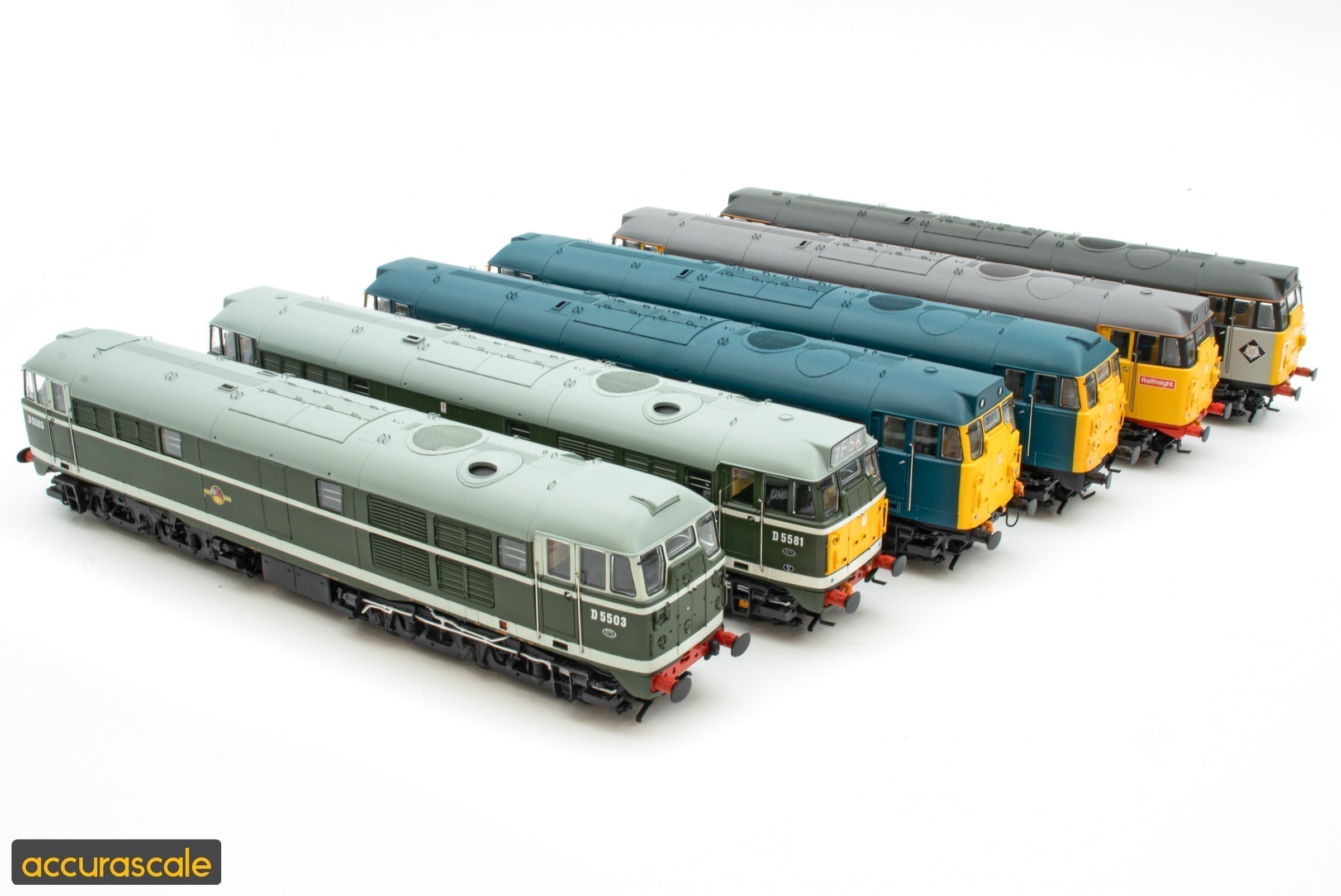
No sooner has run two of our award winning and widely loved Class 31s arrived, that demand has been loudly calling for the next run.
We already previewed that the run would be led by Accurascale Exclusive 31160 "Phoenix" in its RFD guise with a twist! But what about the main range?
Well, wonder no more as we reveal them below!
D5503 BR Green (as delivered)

Our third ‘Toffee Apple’ release represents D5503 as delivered to 30A Stratford depot in January 1958, after it quickly settled into life around East London and on the ex-Great Eastern and Midland & Great Northern Joint lines in East Anglia. It worked almost any service its home shed could throw at it. The 1,250 hp Mirrlees Type 2s were not uprated like their ‘production’ colleagues and, along with the English Electric Type 1s and Type 4s, were among the most reliable of the pilot scheme locomotives, albeit underpowered.
In those early years of dieselisation, they could be found working everything from express trains out of Liverpool Street to Clacton, Norwich, Cambridge, and King’s Lynn; block freights from Essex onto the Western and Southern Regions; busy holiday services to Great Yarmouth, Hunstanton, and Lowestoft; and pick-up wagonload services on the region’s extensive pre-Beeching branch line network. In April 1959, it was one of eight members of the small fleet to transfer to 31B March, although it returned to Stratford by the following December.

D5503 wears its distinctive original paint scheme, with ‘eggshell’ blue window surrounds and bodyside stripes, which was only applied to D5500–D5519. This lasted into the early 1960s before the small fleet began receiving small yellow panels and were repainted into the same ‘production’ livery as carried by our model of D5501 in the second run. Renumbered 31003 in March 1974, it lasted until the final year of the type and was withdrawn in February 1980 along with 31005. It was quickly moved to Doncaster Works, where it was cut up five months later.
D5581 BR Green w/SYP

Outshopped from Brush’s Falcon Works, Loughborough, exactly two years after our other third-run green machine D5503, ‘production’ headcode box-fitted D5581 wears the eternally popular British Railways green with small yellow panels livery. New to 32A Norwich Thorpe in January 1960, it moved to 32B Ipswich just over a year later, and then to 30A Stratford 12 months after that, before settling at 31B March in June 1962.
With competition from English Electric Type 3s, the uprated 1,365 hp Mirrlees-powered Class 30s could still be found on express trains, but were more likely rostered on secondary passenger and freight services. Following the major rationalisation of the East Anglian railway network, it joined the exodus of motive power from the region, moving to 41A Tinsley in January 1966 via a stop at Doncaster Works to receive its EE 12SVT upgrade. Renumbered 31163 in February 1974 when allocated to Leeds Holbeck, it later became part of the second wave of Class 31s to migrate to the Western Region to replace withdrawn diesel hydraulics in 1976.

After a long career, it was eventually stored at Immingham in January 1999 and sold to the Colne Valley Diesel Group for preservation. Before moving to their home railway, it was sold on to the Chinnor & Princes Risborough Railway, where it is still based and currently wears the attractive Derby RTC livery with the fictitious number 97205, inspired by the real research department Class 31 97204, scrapped in March 1997. Unfortunately, it was involved in a collision in 2022 and is still undergoing repair at Nemesis Rail, Burton-upon-Trent.
31138 BR Blue

Just 20 of the production build of 243 Brush Type 2s retained the disc headcode arrangement and cab roof-mounted horn enclosure, making them externally very similar to the pilot scheme ‘Toffee Apples’, although without the distinctively shaped power handle that gave the latter their nickname. Our chosen example is BR Blue 31138, an incredible survivor, which was the last original condition ‘skinhead’ to remain in traffic. The former D5556 of October 1959 just fell short of its 30th birthday after being withdrawn from Crewe Diesel in February 1989.
Even more remarkably, after having its front connecting doors sealed in the late 1970s, it retained the same basic appearance for its last 11 years in traffic, albeit with the addition of an orange cantrail stripe and departmental LMR branding in its final months. This period covered a diverse range of allocations to the Class 31 hotspots of Bescot, Cricklewood, Immingham, and Stratford.

Despite losing its front doors, like most of its colleagues it retained the outer pair of indicator discs, keeping a visual connection to the steam-era train identification system. Typical duties included parcels, departmental workings, and freight, as well as a diverse range of passenger operations including DMU substitutions and the famous Table 18 services between Birmingham New Street and Norwich/East Anglia. It was finally cut up at MC Metals, Glasgow, in January 1990.
31160 Phoenix (unofficial) Railfreight Distribution ACC EXCLUSIVE

By the launch of the iconic Roundel-designed Railfreight scheme in October 1987, around 30 Class 31s were allocated to the FGWC pool at Tinsley for Speedlink wagonload services. With the fleet only recently refurbished at Doncaster Works and Railfreight Distribution looking to standardise on Class 37 and 47 motive power, there was no hurry to repaint them in the new image.
However, following serious fire damage to 31160, the South Yorkshire depot resurrected and outshopped the Brush machine in November 1989 with a full repaint in the new image with RfD markings, making it instantly unique. Typically for Tinsley, the makeover was wildly different from other Railfreight repaints undertaken around the same time for the Coal, Construction, and Petroleum sectors, including large TOPS numbers, distinctive black window surrounds, and the location of the body break line between the two shades of grey. This was all finished with red bufferbeams.

Its one-off appearance was compounded just a few days later when the former D5578 was given the unofficial, but very appropriate, name Phoenix, painted over the squadron symbol with a representation of the mythical bird surrounded by flames. Within a year, Tinsley’s Class 31 fleet had been transferred away, and 31160 was stripped back to its basic triple grey scheme for a new life in the Crewe Diesel departmental pool. It was eventually stored unserviceable in March 1996 and scrapped at Wigan CRDC in June 1999.
31296 Amlwch Freighter / Trên Nwyddau Amlwch Railfreight (orange cantrail stripe)

The first week of September 1986 saw recently refurbished 31296 plucked from anonymity for what was described at the time as a ‘double first’. Despatched to Anglesey in North Wales, the Cricklewood-allocated locomotive became the first Class 31 (and Type 1 or Type 2) to be named, as well as the first to receive dual Welsh and English nameplates, carrying Amlwch Freighter and Trên Nwyddau Amlwch on opposite sides of the body.
This event commemorated the four-decade partnership between British Rail and Associated Octel, as well as 33 years of rail shipments from the Anglesey plant, at the time the world’s largest producer of liquid bromine. This was the final relaxation of BR’s restrictive rules on naming that had been steadily eroded over the previous decade.

Wearing the later standard Railfreight grey livery with orange cantrail stripe, our model is provided with etched metal nameplates and a pair of the distinctive hexagonal Octel headboards worn by this Brush machine on its big day. It was reallocated to Bescot in May 1987 and then to Stratford in January 1989, seeing plenty of passenger use in the Midlands and North West during this time – and even as far south as Devon – as well as its regular freight duties. It was repainted in triple-grey with Construction branding towards the end of that year, and initially retained its nameplates.

These were removed in March 1990 and transferred back to Railfreight Distribution, where they were refitted to Tinsley’s 47330. The former D5829 was withdrawn from Crewe Diesel in March 1993 but survived onto the books of EWS. It was eventually disposed of at the LNWR site in January 2004.
31447 BR Blue

Recognising the calls for a mid-1980s plain blue Class 31/4 is 31447, converted from 31295 in July 1984. This had been an early exile to the Western Region in 1973 while still carrying its original (D)5828 number and BR green livery. However, unlike most of its colleagues, it returned to East Anglia after just a couple of years before being transferred to Toton in October 1984, its last allocation before receiving a Heavy General Overhaul at Doncaster Works and conversion as part of the second series of ETH-fitted machines.
Notably, like 31160 and 31296, this locomotive was outshopped from refurbishment with the headlight in the ‘offset’ position (under the driver’s window), only the second Class 31 to be so configured. On release, it became a stalwart of the Immingham passenger fleet, mostly dedicated to Trans-Pennine, Settle & Carlisle, and Norwich–Birmingham services, all of which had seen an increase in loco-hauled diagrams after the withdrawal of life-expired multiple units.

Following the introduction of new Class 156 ‘Super Sprinter’ units in 1988, it moved to Tinsley in August, where it became more common on freight and departmental workings. Having had its livery tweaked with the orange cantrail stripe in 1987, it gained the general grey scheme in June 1989, which was modified into ‘Dutch’ just over a year later. By this point, it had been renumbered 31547 after its ETH equipment was isolated. It was stored at Toton from July 1994 and officially retired in September 1996. It was cut up by TJ Thomson, Stockton, in November 2002.
Price, Availability and Pre-Ordering Options

As ever, we strive to offer the British outline modeller the very best bang for their bucks, and in the case of the Class 31 it is no different! We're maintaining the pricing from the last run of £184.95 for the DC/DCC-ready variant and £284.95 for the DCC Sound locomotive, despite inflationary pressures. All that industry leading specification, wrapped up in a museum quality finish, leads you to the best value in the market today.
Industry-Leading Model Specification
Our Class 31 model features an extensive, high-end specification developed from original drawings, 3D scanning multiple surveys of real locomotives and historical research. Key features include:
- Highly detailed bodyshell with accurate cab front variants, roof panels and radiator grille tooling
- Separately fitted etched and injection-moulded details throughout, including handrails, lamp irons, pipework and grilles
- Correct bufferbeam configurations with fully detailed pipework and multiple accessory options
- Finely rendered bogies with prototypically accurate brake rigging and suspension detail
- Heavy die-cast chassis for excellent haulage and stability
- Five-pole skew-wound motor with twin flywheels
- All-wheel electrical pickup for reliable operation
- Accurathrash Factory-fitted speakers in DCC Sound versions with custom-recorded sound project
- Working directional lighting with accurate headcode illumination and cab lighting
- Etched nameplates and headboards supplied where applicable
- Prototype-specific detailing applied per individual locomotive and era
- Museum-quality paint finish with crisp lining, markings and data panels
This comprehensive specification ensures that our Class 31 delivers exceptional realism, performance and value, setting a new benchmark for ready-to-run British outline diesel locomotives.

Delivery is slated for Q1 2027, and you can order all the main range either direct, using our no money down or flexible payment options, or via your local Accurascale stockist.
Browse the full range and pre-order direct via the link below!
Pre-Order Your Class 31 Here!


